AI-Enhanced Workflows: What AI Quality Estimation Really Means for Localization
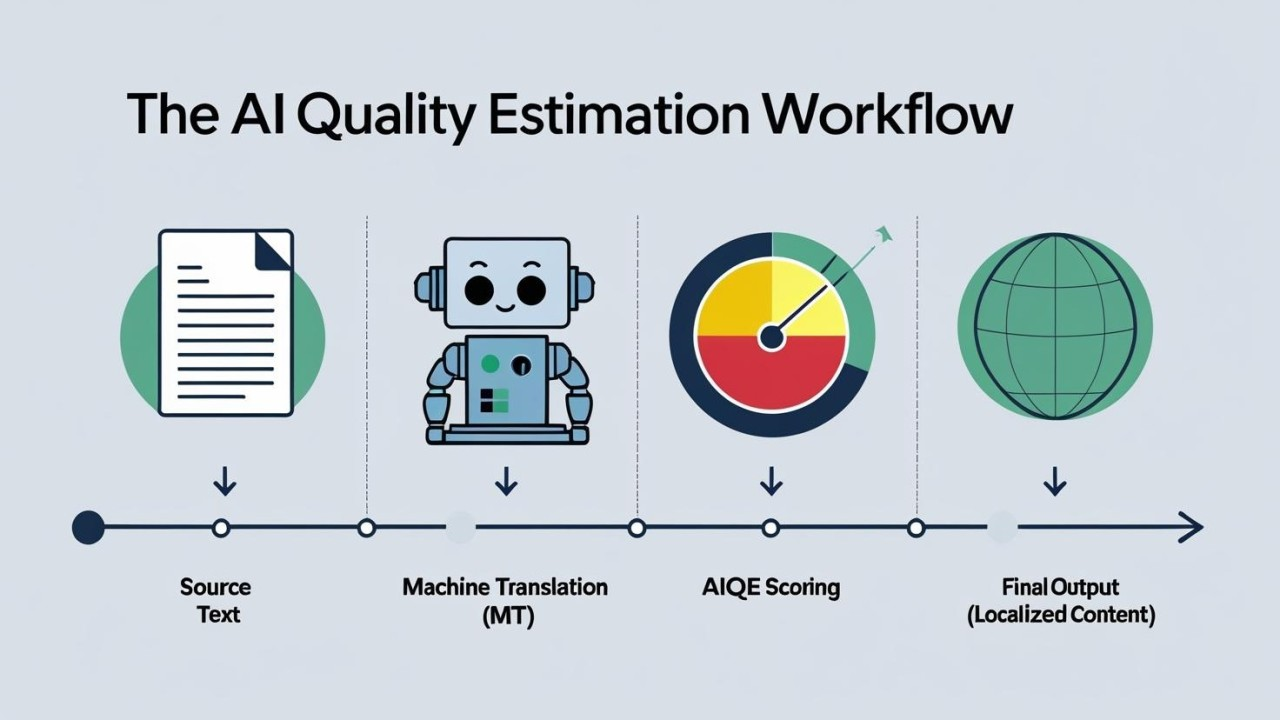
“AI-enhanced” is everywhere right now. But what does it actually look like in localization workflows? Let’s break down one example you’ve probably heard about: AI Quality Estimation (AIQE).
What Is AI Quality Estimation (AIQE)?
AIQE predicts how good a machine translation is without comparing it to a reference translation.
- High-confidence score → publish directly
- Medium score → light editing
- Low score → full post-editing
This allows content to be routed intelligently, saving time and resources.
The Promise
- Streamlined workflows
- Reduced post-editing costs and efforts
- Faster time-to-market
- Easy scaling
In short: make translation pipelines more efficient.
Insider Details
AIQE isn’t plug-and-play. To work well, teams need to account for:
- Domain training: Models are more accurate when trained on specific content types.
- Custom thresholds: Routing depends on extensive testing and calibration.
- Language pair differences: Some languages perform much better than others.
- Hidden costs: Running AIQE systems adds expenses — factor this into ROI.
The Overconfidence Problem
AIQE sometimes gets it wrong — confidently.
- Clean training datasets don’t match messy real-world content
- Profanity and informal language are disproportionately penalized
- Gender bias detection is weak in morphologically rich languages
- Ambiguity in source text leads to inflated confidence scores
Where AIQE Works Best
- High-volume informational content
- Technical documentation with clear terminology
- Languages with robust QE training
- Content where occasional false positives/negatives are tolerable
Success Factors
- Treat AIQE as a routing tool, not a guarantee of quality
- Always combine it with human expertise
- Use robust validation and monitoring
- Integrate it with a strong LQA program
Closing Thought
AIQE is not a magic wand, but when applied thoughtfully, it can be a powerful accelerator. Like any AI tool, its success depends on context, calibration, and human judgment.
What’s your take? Would you trust AIQE in your workflows — or does it raise more questions than it answers?

If rework, delays, and rising costs are your localization reality, here’s how to fix it—and futureproof it.
Rework Is the Enemy of…
In today’s global business environment, translation is table stakes.
You can work with almost any Language Service Provider (LSP) and…