+1 (410) 451-4297
connect@compasslanguages.com

Localization Strategy
Performance Localization vs. Translation: What's Actually Different?
When organizations expand globally, one question appears early in the process: Do we need translation, localization, or something more?
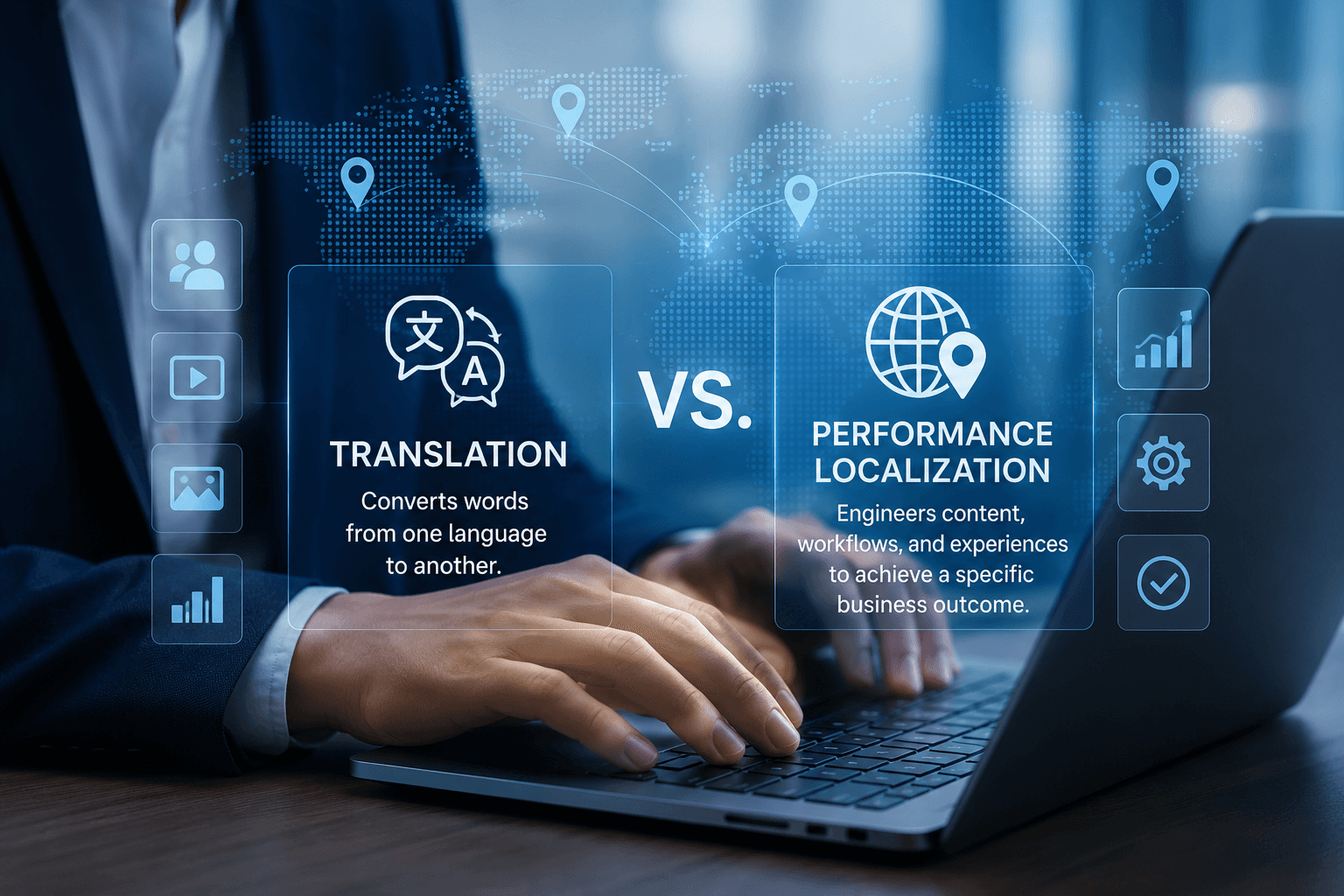
The answer is simple: translation converts words from one language to another. Localization adapts content for a market. Performance localization engineers content, workflows, and experiences to achieve a specific business outcome.
That difference affects everything downstream, from the project brief and production process to quality assurance, stakeholder involvement, and success metrics.
If your goal is simply to communicate information accurately, translation may be enough. If your goal is to drive engagement, learning outcomes, conversions, adoption, or revenue growth across markets, performance localization becomes essential.
Translation vs. Localization vs. Performance Localization
Translation is one component of localization.
Localization is one component of performance localization.
The distinction matters because organizations often assume that if content has been translated, it is ready to succeed globally.
In reality, language is only one variable in a much larger system.
When Translation Works Perfectly Well
Not every project requires a complex localization strategy.
Translation is often the right choice when the primary objective is to communicate information clearly and accurately without influencing behavior or creating an emotional connection.
Common examples include:
Legal contracts and compliance documents
Technical specifications
Safety instructions
Internal communications
Product manuals
Scientific reports
Regulatory filings
In these scenarios, accuracy and consistency are the priority. The content's purpose is to transfer information rather than drive engagement or influence decision-making.
For many organizations, translation is the fastest and most cost-effective option for these use cases.
Where Translation Starts to Break Down
Translation alone becomes insufficient when content is designed to change behavior, create understanding, or build trust.
Consider the complexity of a global training program.
A script update affects subtitles. Subtitle changes impact voiceover timing. Updated visuals require on-screen text revisions. Regional reviewers submit feedback that creates new versions. Formatting breaks inside the learning management system.
The challenge is no longer linguistic accuracy. It becomes workflow coordination.
The same dynamic applies to customer-facing content.
A direct translation may preserve meaning while missing the cultural context that drives engagement and action. Messaging that resonates in one market may feel irrelevant, confusing, or even inappropriate in another.
Translation often struggles with:
E-learning and training programs
Marketing campaigns
Product launches
Video content
Websites and digital experiences
Customer onboarding journeys
Brand messaging
Sales enablement materials
These content types succeed or fail based on audience response, not linguistic accuracy alone.
The question shifts from "Was this translated correctly?" to "Did this achieve the intended outcome?"
Performance Localization: Engineering for Outcomes
Performance localization begins with a different assumption.
Instead of asking how to translate content, it asks what the content is supposed to accomplish.
Is the objective to increase course completion rates?
Improve learner retention?
Accelerate product adoption?
Increase conversions in a specific market?
Reduce support tickets?
Expand revenue in new regions?
Once the outcome is defined, every decision in the localization process aligns around that objective.
This changes the nature of the project brief.
A traditional translation brief might include:
Source files
Target languages
Deadlines
A performance localization brief includes:
Business goals
Audience profiles
Success metrics
Market-specific considerations
Content dependencies
Technology requirements
Review workflows
Measurement plans
The result is a fundamentally different process.
Performance localization treats content as part of an interconnected system rather than a standalone asset.
Voiceover, subtitles, visuals, learning platforms, content management systems, analytics tools, approval workflows, and regional stakeholders all become part of a coordinated process.
Success is measured by whether it helped move the needle toward the desired result.
Translation vs. Localization vs. Performance Localization: How to Choose
The larger your global content operation becomes, the more valuable performance localization becomes.
Because global growth challenges rarely come from translation quality alone.
They come from fragmented workflows, inconsistent experiences, disconnected technologies, and a lack of visibility into what drives results across markets.
Translation answers the question: What does this say?
Localization answers: How should this feel in this market?
Performance localization answers the most important question of all:
What outcome are we trying to create, and how do we engineer the entire experience to achieve it?


Learn more
Contact
connect@compasslanguages.com
+1 (410) 451-4297
147 Old Solomons Island Rd, #302
Annapolis, MD 21401
Copyright © 2026 Compass Languages. All Rights Reserved